




Economic weakness combined with rising inflation is a dilemma for monetary policy
Bank of Canada Holds at 2.25% and Warns of Policy 'Dilemma'



-9202620935848.jpg)
-9202620935849.jpg)

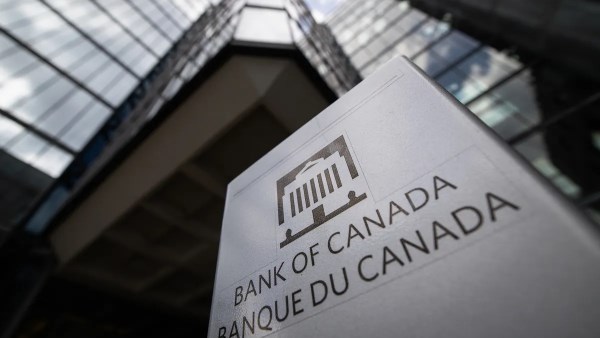
The Bank of Canada held its key interest rate but reiterated that U.S. trade uncertainty and the Iran war may mean it needs to either cut or deliver consecutive hikes to keep inflation stable.
The central bank maintained its policy rate at 2.25% on Wednesday for a fifth consecutive time, matching expectations of markets and forecasters, as the economy remains weak and the global oil shock drives up inflation.
“Economic weakness combined with rising inflation is a dilemma for monetary policy. Raising rates to dampen inflation could further slow the economy. Easing rates to support growth increases the risk that higher inflation becomes persistent,” Governor Tiff Macklem said in prepared remarks.
“For now, holding the policy rate unchanged balances those risks.”
However, Macklem said monetary policy needs to be “nimble” as uncertainty remains elevated. He repeated language from the April decision on the potential need to cut the policy rate to support growth if the U.S. imposes “significant new trade restrictions.”
“Alternatively, if the conflict in the Middle East continues and higher energy prices start leading to ongoing generalized inflation, monetary policy will have more work to do — there may be a need for consecutive increases in the policy rate,” Macklem said.
The loonie was stronger on Wednesday, keeping gains after the decision. It advanced 0.3% on the day, trading at $1.3903 per U.S. dollar as of 9:50 a.m. in Ottawa. Canadian bonds remained steady after the decision.
“By retaining the word ‘consecutive’ for hikes in a possible high oil price and generalized inflation scenario, the bank continued to play into market expectations that the magnitude of risks is not symmetric,” Andrew Grantham, senior economist at CIBC, said in a report to investors.
“Overall, however, we view today’s communication as highlighting a very patient central bank that has plenty of time to wait and see how risks to the economy play out.”
The central bank noted there has been limited evidence of broad-based pass-through of higher energy prices to other prices. However, the governor said oil prices have remained elevated as the Iran war persists, and the price of a barrel is roughly $10 higher than the central bank assumed in its April monetary policy report.
“Based on this, we expect CPI inflation to hover close to 3% in coming months before easing gradually toward 2%,” Macklem said.
Canada’s inflation rate reached 2.8% in April amid higher energy prices, but was still lower than economists had anticipated. Core measures of inflation also eased that month, suggesting underlying price pressures remain under control.
The Bank’s decision to hold follows weaker-than-expected GDP data that showed the economy contracted in the first quarter at an annualized rate of 0.1%, following a 1% contraction in the fourth quarter.
The central bank said on Wednesday that while growth appears on track to resume in the second quarter, it expects the economy to remain in excess supply.
“Overall, the decision suggests that the BoC is in no hurry to change its policy rate,” Charles St-Arnaud, chief economist at Servus Credit Union, said in an email. “We continue to believe the BoC will leave its policy rate unchanged for the rest of the year.”
Macklem and Senior Deputy Governor Carolyn Rogers will speak to reporters at 10:30 a.m. Ottawa time.
-920252122624392.jpg "TOREC")