




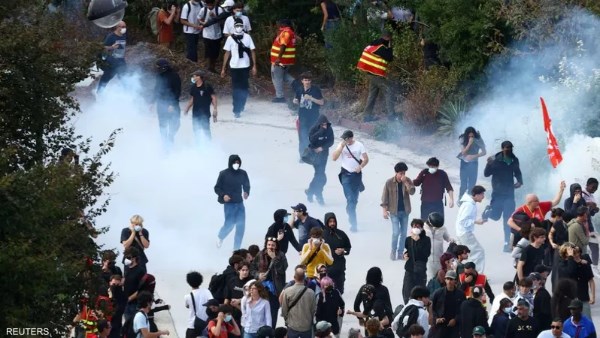
Student protests over underfunding in education continue to rock France
Nobel winner Krugman says France may have become ‘too big to save’



-9202620935848.jpg)
-9202620935849.jpg)

France faces a potential debt crisis and may have become “too big to save” for the European Central Bank, according to Nobel laureate economist Paul Krugman.
Student protests over underfunding in education continue to rock France, as Prime Minister Sébastien Lecornu faces a struggle to pass a contentious 2027 budget that seeks to impose tens of billions of dollars’ worth of fiscal consolidation.
Writing in a Substack blog post on Thursday, Krugman said France was on a “fiscally unsustainable path,” facing mounting interest on its government debt while exacerbating its high debt-to-GDP ratio with large budget deficits.
A key issue is the country’s failure to address its relatively low retirement age as the population ages, he argued.
“France’s reliance on the euro means that it’s all too easy to see how this loss of confidence could turn into an ugly crisis... We saw this movie in 2009-2012, first in Greece, then in Portugal, Spain and Italy,” Krugman wrote, referring to the Sovereign Debt Crisis that spurred extensive intervention by the ECB.
“First, investors stop buying a euro-area nation’s bonds, raising the specter that the government will be forced into default because it simply doesn’t have the cash to pay interest and principal on its debt. Fear of default then leads to even more capital flight, which increases fears of default and the interest rate, and the vicious circle deepens.”
The ECB’s famous 2012 reassurance to markets by then-president Mario Draghi that it would do “whatever it takes” to avoid national defaults was accepted in large part because southern European nations engaged in “massive spending cuts,” Krugman noted.
Bailing France out would be “extremely expensive” for the ECB and politically contentious as long as the country is moving “even further from fiscal responsibility,” he continued.
“France may have crossed the line from too big to fail to too big to save. In short, it’s all too easy to describe a really ugly scenario for a French crisis that would be extremely divisive within Europe,” he wrote.
French government must ‘deliver something that will be credible’
Speaking to CNBC on Friday, former ECB chief Jean-Claude Trichet urged politicians to find compromise to bring down the deficit of the EU’s second-biggest economy.
Trichet, who led the ECB from 2004 to 2011, said: “The ball is in the camp of the French government and parliament, and they have hard work to do.”
“Of course, if there is destabilization, the instruments are very numerous and proved in the past to be very effective. And I have known, of course, such a period in my own time,” the former Bank of France governor told CNBC’s “Squawk Box Europe.”
Such instruments include the European Stability Mechanism and, at the most extreme end, the ECB’s Transmission Protection Instrument (TPI), an as-yet unused measure finalized in 2022 that is intended to ensure market stability in times of fragmentation in the euro area.
Intervention would require the French government to reach out to the ECB to ask for help, which it currently states is not needed, Trichet said.
“My recommendation to all political sensitivities in France, and you know that the situation is complex in terms of political preparation for the presidential election, but I would ask all of them to be responsible in those circumstances.”
“All political sensitivities, whatever they are, they have to understand that it is about time to prove that France, the market player, that they are responsible.”
“I call on them, of course, to be as, I would say, effective in their discussion as possible and prove that they can deliver something which would be credible. That, of course, is one of the conditions to activate TPI,” he said.
Trichet said his own experience during the Sovereign Debt Crisis showed that “you first have to help yourself, because we cannot win if you are not yourself convincing market participants, investors, and savers that you are credible.”
“Of course, you have to get the country convincing itself that it goes in the right direction. That goes without saying. It is the conviction, if I understand well, of the governor of Banque de France and of the French government,” he added.
-920252122624392.jpg "TOREC")