




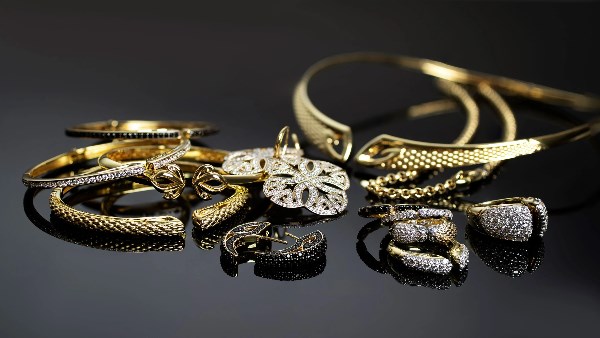
The trend comes as investors increasingly flock to tangible assets
Wealthy consumers are turning to jewelry as an investment, especially colored gemstones



-9202620935848.jpg)
-9202620935849.jpg)

When the gavel came down in December, Christie’s had set a record that created a buzz in the auction world.
A Tiffany & Co. necklace adorned with a sparkling blue Paraiba tourmaline gem and diamonds sold for more than $4.2 million, 10 times its low estimate. A matching pair of earrings hit the block next, and it too sold for 10 times its estimate.
“I think that was really a marker for how far private clients are willing to go for these exceptional goods,” said Jacqueline DiSante, vice president and head of sales of Christie’s New York jewelry division.
Amid economic and geopolitical uncertainty, a certain class of consumers are turning toward an unlikely asset class — jewelry. The trend comes as investors increasingly flock to tangible assets. For ultrarich consumers, colored gemstones such as rubies, sapphires and emeralds are especially popular right now.
“Whenever you have macroeconomic volatility … the appeal of hard asset investing goes up,” said Thorne Perkin, president of investment management firm Papamarkou Wellner Perkin. “Tangible assets, they tend to retain their value or even increase when inflation rises.”
Mario Ortelli, a managing partner at strategic and M&A advisor Ortelli&Co., agreed with Perkin’s take, saying that there was clearly a “defensive element” to the trend.
“In periods of inflation, geopolitical tension, or financial market volatility, tangible assets become more attractive,” he said in an email. “Branded jewelry can function as a portable store of value.”
“Unlike fashion accessories that are tied to seasonal cycles, iconic jewelry collections have a much longer product life cycle,” he added. “In many cases, they also demonstrate stronger resale value dynamics than handbags. That longevity and perceived capital preservation help explain jewelry’s relative resilience versus soft luxury.”
Luca Solca, global head of luxury goods at Bernstein, estimated that roughly one-third of the renewed interest in gold-heavy and gemstone-driven jewelry could be tied to “flight to safety” behavior for investors.
-920252122624392.jpg "TOREC")